
Calendly
To properly track user booking a call connecting Calendly to SegMetrics is optional. Properly configuring Calendly is not. This integration guide provides enhanced tracking setup for embedded forms or direct Calendly links where automatic tracking may not work.
Check out this video to learn more about the benefits of connecting Calendly to SegMetrics:
Step 1: Install SegMetrics Tracking
Ensure the SegMetrics tracking pixel is installed on your website:
- In SegMetrics, navigate to Site Setup from the gear menu
- Copy the tracking pixel code
- Install it on your website following the Installing the Tracking Pixel guide
- Create a thank you page on your site for Calendly booking confirmations
Note: If you are sending a user to a calendly page where a SegMetrics pixel is not installed, we will not be able to track where that user came from. To get aroudn this, you can embedd a Calendly signup on your own site where you can put the SegMetrics pixel.
Step 2: Configure Calendly Event
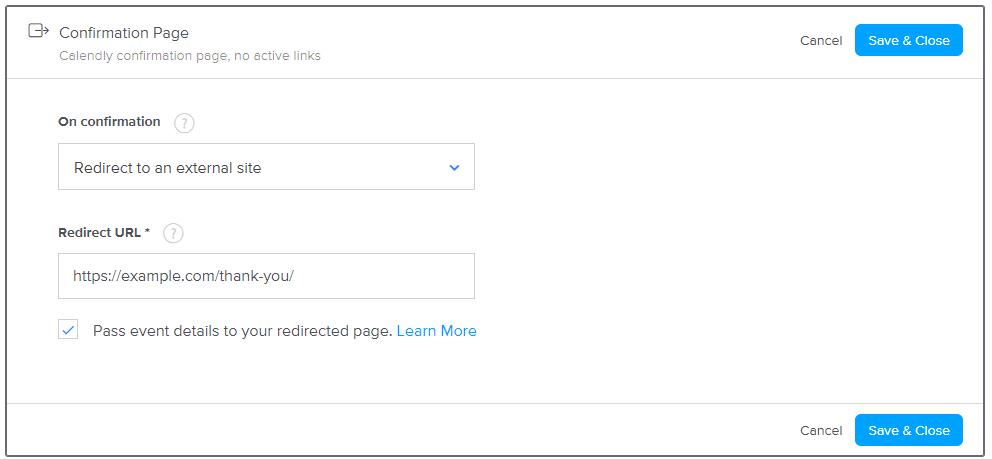
Set up your Calendly event to redirect to your tracking page:
- In Calendly, click on the event you want to track
- Click Confirmation Page
- Set On Confirmation to "Redirect to an external site"
- Enter your thank you page URL
- Check the box for "Pass event details to your redirected page"
- Click Save & Close
Step 3: Add Tracking Code
Add the following JavaScript to your thank you page footer to capture the email from Calendly's URL parameters:
<script>
setTimeout(function(){
    _segq.push(['optin', {email: SegMet.queryVal('invitee_email') }]);
}, 1000);
</script>
This code extracts the email address from the URL parameters that Calendly passes to your redirect page.
Understanding the Data Flow
When someone books a Calendly appointment, the system redirects them to your thank you page with booking data in the URL:
Example URL:
https://example.com/thank-you?assigned_to=awesome&event_type_uuid=AAAAABBBBCCCCC&event_type_name=Awesome%20Sauce&event_start_time=2020-06-26T15%3A00%3A00%2B10%3A00&event_end_time=2020-06-26T15%3A30%3A00%2B10%3A00&invitee_uuid=BBBBBBBBBBBB&invitee_full_name=Luke&invitee_email=test%40gmail.com
The tracking code extracts the invitee_email parameter and sends it to SegMetrics for lead tracking.
Testing Your Integration
- Book a test appointment through your Calendly link
- Confirm you're redirected to your thank you page
- Check that the URL contains booking parameters
- Verify the lead appears in SegMetrics within a few minutes
- Look for the contact in your SegMetrics dashboard under the appropriate campaign or source
Frequently Asked Questions
Q: Does SegMetrics automatically track Calendly bookings?
A: No, SegMetrics requires proper configuration to track Calendly leads. You must set up Calendly to redirect to a thank you page with the SegMetrics tracking pixel and add the tracking code shown in this guide.
Q: What if I don't set up this redirect configuration?
A: Without the redirect setup, SegMetrics won't track your Calendly leads. The tracking pixel needs to be on a page that receives the booking data from Calendly to capture contact information.
Q: Can I track Calendly leads on the Calendly-hosted confirmation page?
A: No, you cannot install the SegMetrics tracking pixel on Calendly's hosted pages. You must redirect to your own thank you page where you can install the tracking code.
Q: What if my thank you page doesn't receive the URL parameters?
A: Ensure you've checked "Pass event details to your redirected page" in your Calendly event settings. Without this option enabled, the booking data won't be passed to your redirect page.
Q: How quickly do leads appear in SegMetrics after booking?
A: Leads typically appear in SegMetrics within a few minutes of booking. The 1-second delay in the tracking code ensures the page fully loads before sending the data.
Full Transcription:
Hey there. Quick question. Do you actually know which of your marketing channels are booking you the most calls? Or which of those calls are actually turning into paying customers? If Calendly is just living in its own little bubble disconnected from the rest of your marketing, you're missing a huge piece of the puzzle. Today, I'm gonna show you how connecting Calendly to SegMetrics lets you track every single call booked, attended, and closed all the way back to the marketing that drove it.
calendly is great at scheduling calls. It's just never been built to tell you whether those calls are worth your time. It can tell you someone booked a slot, but it can't tell you which ad, email, or landing page got them to book in the first place.
And once the call happens, Calendly definitely can't tell you whether it turned into revenue. That disconnect is the real problem, especially if you're running a sales team or booking discovery calls as part of your funnel. Without it, you're stuck guessing which channels are sending you qualified prospects who are actually gonna buy and which ones are just sending you a bunch of no-shows who are never gonna convert in the first place.
You end up burning your ad spend and your sales team's time on the wrong leads. That's exactly where SegMetrics comes in. Connect Calendly, and suddenly every call booked has a full story behind it from the very first click all the way to the close.
All right, let's jump into SegMetrics and I'll show you how this works. Connecting Calendly is easy. Head over to the integrations page, find Calendly in the list, and authorize the connection. Once that's done, every call booked through your Calendly link starts flowing into SegMetrics automatically, right alongside the rest of your marketing data. Now, to actually track all of those different call statuses, here's the trick: tags.
Inside your CRM or email tool, set up a tag for each stage of the call, whether that's call booked, call attended, call canceled, call rescheduled, so on. Every time a call moves through one of those stages, the tag gets applied to the contact. Since your CRM is already connected to SegMetrics, those tags flow right in, and now every call status is fully trackable right alongside your marketing data. But booking a call is only half the story. What you really wanna know is whether those calls turn into revenue. So let's pull up the orders dashboard and filter down to contacts who booked a call.
Add a new filter at the top of the dashboard using the appropriate tag to segment the data. Now check this out. You've earned forty thousand dollars in revenue from people who have booked a call in the last thirty days. It's not too shabby. Take a look at the top sources widget here. This tells you which marketing channels are responsible for that revenue. It's pretty obvious that the paid channel, most of your Facebook and Google ads are bringing in over thirty thousand dollars of that revenue. Now here's where it gets good. Head over to the advertising dashboard, and you'll see exactly which campaigns are bringing in those booked calls and revenue. Here we can see that the retargeting campaign is bringing in most of those booked calls and accounting for most of that revenue. It's a great idea to keep investing in that channel to continue bringing in your qualified sales leads that turn into booked calls and revenue. And once all those tags are flowing in, you can install the call book dashboard template. This gives you a pre-built view of everything happening with your calls. It's calls booked, calls attended, cancellations, and reschedules, all pulled directly from those tags, all in one place. No digging required. Just open the dashboard and see exactly where things stand.
Click the edit icon, and you can start changing this dashboard to fit your needs. Double-click into any of the widgets to change anything you want about it, from the metrics to the visualization. Everything can be customized. Want to add new widgets to the dashboard?
Easy. Just drag and drop new widgets to fill in any gaps and to build out the perfect dashboard for you and your team. Need to share the dashboard throughout your organization? Every dashboard includes a shareable link so anyone can view it, even if they don't have direct access to the SegMetrics account.
Best part is that it's view only, meaning they can't change or move anything around, so the dashboard stays the way it is for everyone in play.
With Calendly connected to SegMetrics and a simple tagging system tracking every call status along the way, you're no longer flying blind between calls booked and deals closed. You can see exactly which channels are sending you calls that are turning into revenue. Double down on those and fix or cut the ones that are just wasting your sales team time. That wraps things up for this episode. We've got lots more videos on the channel and new episodes coming to help you optimize your marketing with SegMetrics.
Don't forget to like and subscribe below. Thanks for watching, and I'll see you next time