
Bing
Bing and SegMetrics gives you the ability to analyze your Bing Ads campaign performance and connect it to other data sources.
With that information, you can easily segment that data into your leads, find the automation triggers that convert to customers, understand where your most valuable leads are coming from, and more!
Check out this video to learn more about the benefits of connecting Bing to SegMetrics:
Integration Overview
SegMetrics takes the spend from Bing Ads and purchases from your payment processor then connects them to the email addresses in your email marketing platform.
You don't need to import the orders or tag people in a special way: they just need to be in your CRM account!
How to connect Bing Ads to SegMetrics
-
Head over to your Integrations page in your SegMetrics account

-
Once you're on the Integrations page, click on the BingAds integration

-
Click Connect BingAds

- If you're not already signed in to your Bing account, you'll be prompted to do so
- Confirm the connection with Bing
- Once you have connected Bing Ads, you'll want to add the tracking value to your ads so that SegMetrics can connect individual users to each click on your ads. Follow the instructions on the screen, or check out our doc on Setting Up BingAds Tracking


How much historical data is synced when you first connect Bing Ads to SegMetrics?
When you connect a new Bing Ads Data Source, we import the last month of ad spend, clicks and impressions for all currently active ads. Lead attribution will start as soon as the ads are configured for tracking.
Pro Tip: Once Bing Ads is connected and actively syncing data, we store the data that's collected in our own database. This allows us to accumulate more data over time as more data syncs are made so that you can report on more historical Bing Ads data in your SegMetrics reports.
How to build a Report using Bing Ads data
Once your data is imported from Bing Ads, you can create reports with the data to see how each touchpoint influences your sales.
-
Head over to the Advertising report

-
Select your desired filters based on dates, tags and touchpoint

-
Save it to come back to or to include the data in a custom dashboard


Frequently Asked Questions
What time zone is Bing Ads data synced in?
Bing Ads data is synced in UTC. SegMetrics reports on your data based in the timezone that you set in your Account Settings.
Why am I not seeing clicks but not any leads in SegMetrics?
When tracking Bing Ads with SegMetrics, you will need to configure your ads with the appropriate tracking value.
In order for SegMetrics to track your ad-spend effectively, you need to add ad_id={AdId} to the Final URL Suffix in the Ad URL Options. You can also add this code at the Account, Campaign or Ad Group level to automatically apply it to all ads. Instructions for this can be found on Microsoft's documentation, here
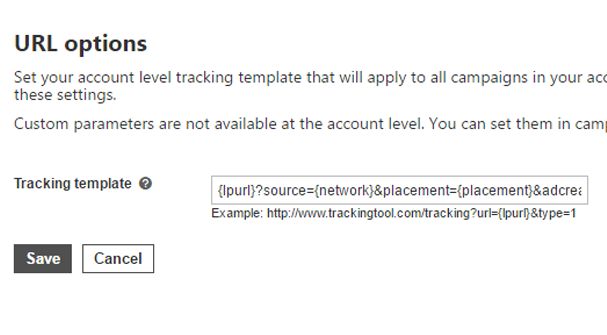
If you would like to automatically generate your UTM values from your ads as well, you can use the following URL Parameters to track the ad-spend as well as UTM values in SegMetrics.
utm_campaign={Campaign}&utm_source=bing-{Network}&utm_medium=cpc&utm_content={AdGroup}&utm_term={keyword:default}&ad_id={AdId}
If you're still not seeing leads come through, please contact us at support@segmetrics.io and we'll get you up and running ASAP!
Here's how to set up your ad-tracking for Bing Ads
- Make sure that the SegMetrics Tracking Pixel is installed on your site & landing pages.
- From your Integrations Page, click on "Manage Settings" for Bing Ads, and choose "Install Ad Tracking"
- Here will be a list of all the ads that we've detected as currently being active, and need to be updated.
- Go into Bing Ads to install the tracking values into the appropriate ads.
Do I need the tracking pixel to get the data found in my Bing Ads account?
You do not need to create a Tracking Link for SegMetrics to track visitors from ads, it will still gather the UTM data. Tracking Links provide a simple way to get further detail of exactly which link they clicked for ads, email broadcasts, or campaigns.
To learn how to create a tracking link, click here to be taken to our URL builder quick walkthrough
Warning about URL Shorteners
It has come to our attention that most URL Shorteners will remove all UTM and Ad Tracking from the final URL,which breaks tracking in SegMetrics, Google Analytics, Keap, and any other tracking systems that you may use. We highly recommend using your FULL URL when creating ads, or use a custom redirection service that will keep the UTM and Ad Tracking values.
You can test this by taking your link shortener, and adding ?utm_campaign=test to the end of it.
Example:
| Shortened URL | https://bit.ly/2LQwjlZ |
| Test URL | https://bit.ly/2LQwjlZ?utm_campaign=test |
| GOOD | https://segmetrics.io?utm_campaign=test |
| BAD | https://segmetrics.io |
If your final URL has the UTM value still attached, then your URL shortener will work. If not, we recommend using the full URL.
(NOTE: Bit.ly USED to pass UTM values to the final page, but they discontinued that feature. Be mindful that third party systems can change at any time)
Full Transcription:
Hey there. So you're running Bing ads.
Maybe it's a small or large piece of your budget, but here's the question that really matters. Do you actually trust the conversion data that Bing is showing you? When Bing says that you got a conversion, do you know exactly who that person is? Do you know if they actually became a paying customer or if that conversion just kind of evaporated somewhere between the click and your bank account?
Today, I'm gonna show you how connecting Bing and SegMetrics gives you the data you can actually trust. It's no secret that Bing Ads gets overlooked. Everyone's obsessing over Facebook and Google, and Bing quietly sits there with less competition and often cheaper clicks. But it also means it's an easy channel to underinvest in because reporting you get just isn't great at telling you the full story.
Bing's own reporting can tell you clicks and conversions, but it can't tell you if those conversions are real people, repeat buyers or fraud. If your sales cycle is longer than a few days, good luck getting Bing to connect a click today to a sale that happens weeks or months down the road.
That's a terrible position to be in. You're making budget decisions, well, keep spending here or cut spending there based on numbers you don't really believe. That's exactly where SegMetrics changes the game. When you connect Bing Ads to SegMetrics, you can stop trusting Bing's version of events and start seeing what's actually happening in your business.
Alright, let's dive into SegMetrics to see how this all works. Bing Ads is a direct integration with SegMetrics, so connecting is easy. Just head over to your integrations page, find Bing Ads, authorize the connection, and we'll start pulling in your ad spend along with all your campaign names, ad set names, and individual ad names.
Everything syncs automatically. You'll also need to make sure that you have your SegMetrics tracking pixel deployed to all of your landing pages and the appropriate tracking parameters attached to your ad URLs. Once that's set up, you're ready to track. Now here's what makes SegMetrics different, and this is huge. With SegMetrics, we track attribution back to a real person with a real email address. So if SegMetrics says you got thirty-nine customers from your ads, we can show you exactly who those thirty-nine customers are.
Not just a number, not an estimate, actual people you can look up in the system. This is data you can actually trust. Now let's jump into the advertising dashboard to see this in action. Here you can see your total ad spend, how many leads clicked on your ads, how many of those became customers, and most importantly, how much revenue those ads actually generated.
Not just immediate purchases, but long-term revenue over weeks, months, and even years. Want to drill down even further? This is where it gets really powerful. Click on any campaign, ad set, or individual ad to see its specific performance. You'll see exactly which ads are profitable and which are burning money.
Here we can dissect your campaigns based on metrics like cost per acquisition, customer acquisition cost, return on ad spend, and more. Check this out. Here we can see that this campaign has a rising ROI with a low customer acquisition cost. Nice. But over here, this campaign has lower ROI and a higher customer acquisition cost with a higher ad spend. It's not so great. This tells us exactly what we need to do. Start shifting budget towards the higher performing campaigns and cut off the losers before they drain your wallet. And here's one of my favorite features in SegMetrics.
You can see the actual customer journey. Click on any of the ads and view the real people who clicked it, when they opted in, what emails they opened, what pages they visited, and when they finally purchased.
This gives you the complete story, not just a conversion pixel firing. You can also change your attribution model on the fly. Want to see first touch attribution to understand which ads start the customer journey? Done. Want last touch to see what closes the deal? Switch it in seconds
With Bing ads and SegMetrics working together, you finally have the data you can trust for a channel most marketers ignore. No more guessing if Bing's conversions are real. You know exactly which campaigns and keywords are bringing in real customers and real revenue, so you can scale the winners with confidence.
Well, that wraps things up. We've got lots more videos on the channel to help you optimize your marketing with SegMetrics. Don't forget to like and subscribe below. Thanks for watching, and I'll see you next time.