
Drip
SegMetrics gives you the ability to analyze your Drip campaign performance and connect it to other data sources.
With that information, you can easily segment that data into your leads, find the automation triggers that convert to customers, understand where your most valuable leads are coming from, and more!
Note: This integration does not provide tag dates. SegMetrics will record the date a tag was first seen rather than the date it was originally applied.
Check out this video to learn more about the benefits of connecting Drip to SegMetrics:
Integration Overview
SegMetrics imports your contacts, custom fields, tags, orders and more directly from Drip. SegMetrics is kept up to date with the most recent information in your Drip account, to make sure you always have access to the information you need.
If you have a payment processor that doesn't connect with Drip natively, we can connect that information together using the email addresses in Drip. But, if you have more than one payment processor we recommend using whichever can act as the single source of truth. You can see which revenue software we have native integrations for here.
You don't need to import the orders or tag people in a special way: they just need to be in your Drip account!
How to connect Drip to SegMetrics
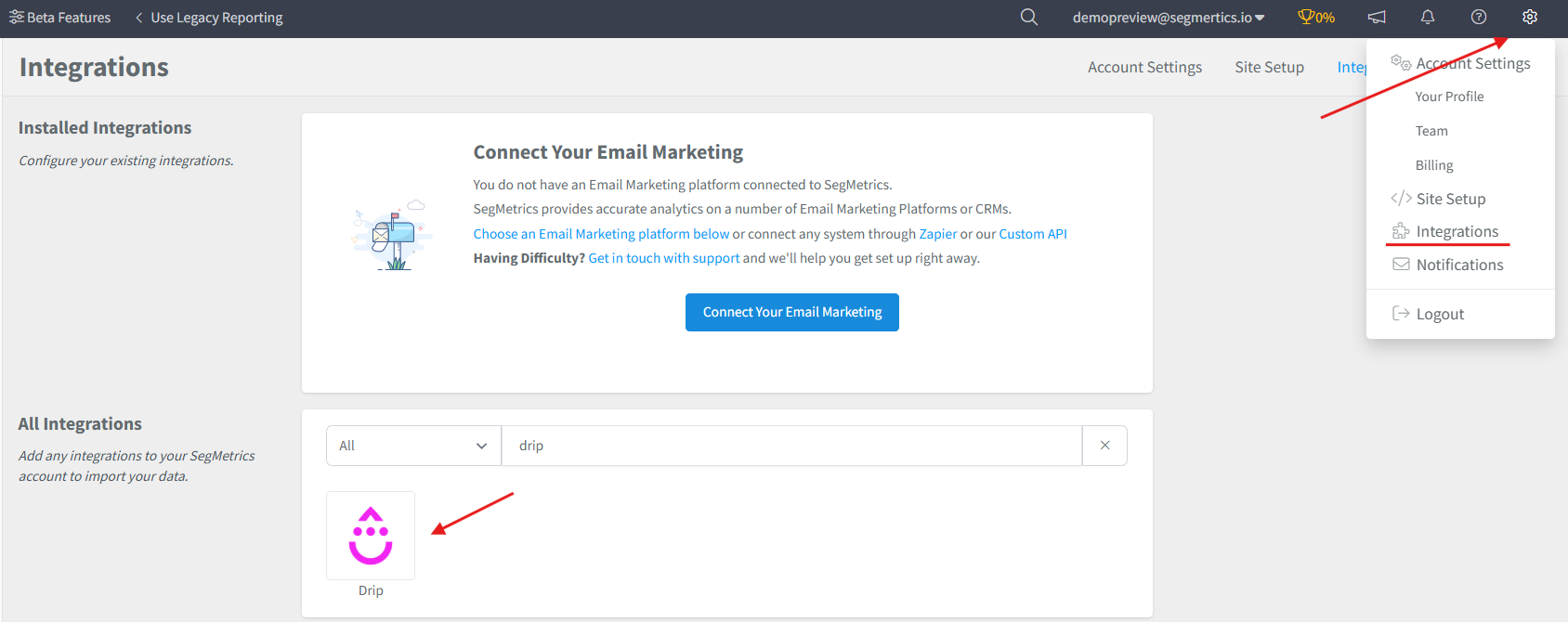
- Click on the gear icon in the top right corner and then click "Integrations"
- Once you're on the Integrations page, select the CRM list and click on Connect next to Drip
- This will open the Activation window, which is where you will be prompted to enter your login details for Drip and authorize the connection.
How to connect payment information to Drip contacts
If you're using Drip's payment integrations, there is nothing left to do: the payment data is integrated automatically.
But, if you do not have a payment integration with your Drip account, you can integrate your payment processor with SegMetrics. We recommend using whichever payment processor can act as your single source of truth. You can see which revenue software we have native integrations for here.
Frequently Asked Questions
Q: How much historical data is synced when you first connect Drip to SegMetrics?
A: When you connect a new Drip integration, all historical data from your Drip account is synced. Once Drip is connected and actively syncing data, we store the data that's collected in our own database. This allows us to accumulate more data over time as more data syncs are made so that you can report on more historical Drip data in your SegMetrics reports.
Q: What time zone is Drip data synced in?
A: Drip data is synced in UTC. SegMetrics reports on your data based in the timezone that you set in your Account Settings.
Q: How can I set up my email links to get click rates from my Drip emails?
A: Drip automatically adds subscriber tracking to your links in the form of _s=1234567. That will tell SegMetrics who is visiting the page, even if they're on a different device.
You can find more information on configuring your email links in our Improving Tracking Fidelity Page.
Q: Do I need to install the tracking pixel on my website to get complete customer journey tracking?
A: Yes, you need to install the SegMetrics tracking pixel on all your web pages. The tracking pixel must be active to capture visitor data going forward and attach it to contacts in your Drip account. SegMetrics will never pull in historical click data - only data from when the pixel is installed.
Q: How do I create a report on my client invoices paid and cart sales found in Drip?
A: If you're looking to use it for more invoice paid clients then using a funnel report might be preferable, as you can set out each step that a client should take through the process (sales call, signup, invoice, payments, etc).
To learn how to quickly create a funnel report, click here to see our funnel reporting walkthrough.
You can also save your reports for later use or to include the data in a custom dashboard.
Full Transcription:
Hey there. So you're running your email marketing through Drip. Nice. But let me ask you this. Do you actually know which of your emails, workflows, or campaigns are the ones driving real revenue? Not just opens and clicks, but actual dollars in the bank? If that's a little fuzzy, stick around.
Today, I'm gonna show you how connecting Drip to SegMetrics gives you the full picture of what's actually working in your marketing. Now, Drip is a really solid tool for e-commerce and marketing automation. Tagging, segmenting, building out your automated workflows. It handles all of that beautifully.
You can watch your subscribers move through your funnels and see the emails they're engaging with. But here's the catch. Drip can tell you who's opening and clicking, but it can't tell you the full revenue story. Which email sequences actually turned a subscriber into repeat customers? Which tag or segment is quietly driving your most profitable buyers? And what happens before someone even landed on your list? Which ad, which blog post, which channel started the whole thing? . That's a lot of blind spots when you're trying to make smart budget decisions. That's exactly where SegMetrics steps in. When you connect Drip to SegMetrics, you're combining all of your Drip data, tags, workflow, subscribers, revenue, with SegMetrics' full funnel attribution engine. Now you get the full story, not just the email piece of it.
All right, let's jump into SegMetrics and I'll show you how this all works. Connecting Drip is easy. Head over to the integrations page, find Drip in the list, and authorize the connection. And just like that, your Drip data, subscribers, tags, custom fields, and revenue starts flowing into SegMetrics automatically Now here's where it gets good.
Once that data's in, you can head to the engagement dashboard to see exactly which of your emails and campaigns are converting subscribers into paying customers and how much revenue each one is actually generating. Want to know which subject line performed best? Drill down email by email and see for yourself.
Next, let's talk about attribution. Switch your attribution model to last touch, and you can see which emails actually sealed the deal right before someone bought.
As we can see here, sales email one is leading the way with around twelve hundred dollars in revenue. Webinar register one is also bringing in some good revenue with five hundred and seventy-five dollars. That means people who registered for our webinar are starting to convert to real customers.
Now let's use SegMetrics' segmentation to dig into your Drip data specifically. You can filter and segment by any of the tags you've set up in Drip. Let's head over to the Nurture dashboard to see all of your tags and associated revenue.
The Segments widget breaks down all of your tags. The Revenue column represents the revenue earned from people who have been applied those tags. Let's say you're running two different funnels set up in your Drip workflows. Since you're a pro, you're already tagging people accordingly depending on which funnel they enter.
Let's compare the performance of two different funnels. Just add a filter to the top of the dashboard. Select Tags. Enter in the tags associated with each funnel. Click Apply. And just like that, we can see which funnel is performing best.
Based on this data, we can see that funnel A is the clear winner with thirteen hundred dollars in revenue versus funnel B with just two hundred dollars in revenue. That's a clear sign that you should be sending more people down funnel A than funnel B. And here's another one worth checking out. Head over to the orders dashboard.
This lets you see exactly which channels and sources are bringing in your best customers, not just the most subscribers. So if you wanna know whether your paid ads or your organic content is bringing in the buyers who actually spend the most, this is where you'll find that answer.
As we can see here, organic social brought in twenty-one K worth of revenue, with your paid ads in close second with another eighteen K in revenue. This paints a clear picture of what you should do next. Double down on organic social content and focus more time on your best-performing paid ads. Need to know which of your paid ads are really working?
Head over to the advertising dashboard. Here, you can break down all of your campaigns, ad sets, and individual ads. This dashboard tells you exactly which ads are holding their worth in ad spend and which aren't. And because SegMetrics tracks long-term attribution, it doesn't matter if they've been sitting on your drip list for a few days or a few years. When they finally convert, you'll know exactly what brought them in.
With Drip and SegMetrics working together, you get the best of both worlds, Drip's automation power and SegMetrics' full funnel visibility. You'll know exactly which emails, segments, channels, and workflows are driving real revenue, not just opens and clicks.
That means you can double down on what's actually working and stop guessing about the rest.
Well, that wraps things up. We've got lots more videos on the channel and new episodes coming to help you optimize your marketing with SegMetrics. Don't forget to like and subscribe below.
Thanks for watching, and we'll see you next time.