
AdRoll
SegMetrics gives you the ability to analyze your AdRoll campaign performance and connect it to other data sources. With that information, you can easily segment that data into your leads, find the automation triggers that convert to customers, understand where your most valuable leads are coming from, and more.
Integration Overview
SegMetrics takes the spend from AdRoll and purchases from your payment processor then connects them to the email addresses in your email marketing platform.
You don't need to import the orders or tag people in a special way: they just need to be in your CRM account!
Setting Up the Connection
- Head over to your Integrations page in your SegMetrics account
- Once you're on the Integrations page, click on the AdRoll integration
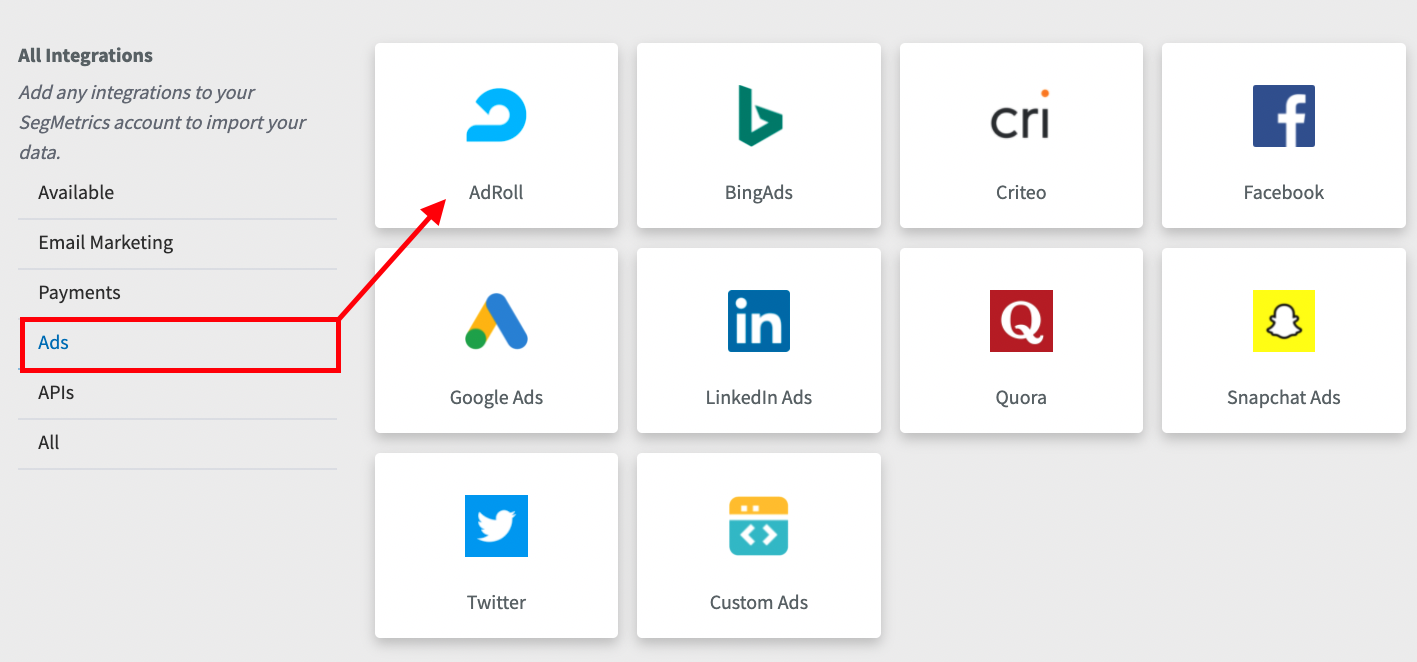
- Click Connect AdRoll
- If you're not already signed in to your AdRoll account, you'll be prompted to do so
- Confirm the connection with AdRoll
Configuring Ad Tracking
- Once you have connected AdRoll, you'll want to add the tracking value to your ads so that SegMetrics can connect individual users to each click on your ads. Follow the instructions on the screen
- Historical Data Import: When you connect a new AdRoll Data Source, we import the 60 days of ad spend, clicks and impressions for all currently active ads. Lead attribution will start as soon as the ads are configured for tracking
Pro Tip: Once AdRoll is connected and actively syncing data, we store the data that's collected in our own database. This allows us to accumulate more data over time as more data syncs are made so that you can report on more historical AdRoll data in your SegMetrics reports.
Using AdRoll Data in SegMetrics
Building Advertising Reports
Once your data is imported from AdRoll Ads, you can create reports with the data to see how each touchpoint influences your sales.
- Head over to the Advertising report
- Select your desired filters based on dates, tags and touchpoint
- Save it to come back to or to include the data in a custom dashboard
What Ad Metrics to Pay Attention To
Understanding the right metrics helps you optimize your AdRoll campaigns for maximum ROI. Focus on these key performance indicators:
Core Performance Metrics
- Return on Ad Spend (ROAS): Your most important metric showing revenue generated per dollar spent
- Cost Per Acquisition (CPA): How much you're paying to acquire each customer
- Conversion Rate: Percentage of ad clicks that result in desired actions
- Customer Lifetime Value to CPA Ratio: Ensures long-term profitability
Attribution Insights
- First-Touch Attribution: Identifies which ads introduce new prospects
- Last-Touch Attribution: Shows which ads drive final conversions
Optimization Opportunities
- Frequency: Prevent ad fatigue by monitoring how often users see your ads
- Audience Overlap: Identify competing campaigns targeting the same users
- Creative Performance: Compare different ad formats and messaging
- Dayparting Analysis: Determine optimal times for ad delivery
Advanced Attribution Analysis
Leverage SegMetrics' powerful attribution capabilities to understand your AdRoll performance:
- Multi-Channel Attribution: See how AdRoll works with your other marketing channels
- Navigate to Reports → Attribution to view cross-channel impact
- Understand which channels work best together for maximum ROI
- Customer Journey Mapping: Track the complete path from ad click to purchase
- View individual contact profiles to see full interaction history
- Identify common conversion paths and optimize accordingly
- Cohort Analysis: Compare performance across different audience segments
- Segment by demographics, interests, or behavior patterns
- Optimize targeting based on highest-value customer characteristics
Frequently Asked Questions
Q. What time zone is AdRoll data synced in?
A. AdRoll data is synced in UTC. SegMetrics reports on your data based in the timezone that you set in your Account Settings.
Q. Why am I not seeing clicks but not any leads in SegMetrics?
A. This can be caused by a couple of factors, but all are easy to solve. Please go through the checklist below to make sure that the tracking is set up correctly:
- Confirm that the Tracking Pixel is installed on all the pages, including the Landing Page that the ads are pointing to, as well as any order forms or optins after the initial landing page. You can use the Tracking Pixel Debugger to make sure that the tracking is installed.
- Make sure that ad_id=[ADROLL:AD_EID] is included in the Final URL and that the ad id is being correctly passed to the landing page.
- Confirm that the leads are entering their email address on a page that has the Tracking Pixel installed, and that if you're using any 3rd Party optin forms (like Acuity, WebinarJam, etc) that they have the tracking pixel installed as well.
- Finally, make sure that the leads are getting added to your email marketing system. (People not getting added to the marketing is more common than you think!)
- If you're still not seeing leads come through, please contact us at support@segmetrics.io and we'll get you up and running ASAP!
Q. Do I need the tracking pixel to get the data found in my AdRoll Ads account?
A. You do not need to create a Tracking Link for SegMetrics to track visitors from ads, it will still gather the UTM data. Tracking Links provide a simple way to get further detail of exactly which link they clicked for ads, email broadcasts, or campaigns.
To learn how to create a tracking link, click here to be taken to our URL builder quick walkthrough.
Q. How much historical data is synced when I first connect AdRoll?
A. When you connect a new AdRoll Data Source, we import from the platform (1 to 1 data) 60 days of ad spend, ad clicks and impressions for all currently active ads. Lead and customer attribution will start as soon as the ads are configured for tracking.
Q. Can I track multiple AdRoll accounts in SegMetrics?
A. Yes, you can connect multiple AdRoll accounts to SegMetrics. Each account will be tracked separately, and you can filter reports by specific accounts to analyze performance individually or compare across accounts.