
Kajabi
SegMetrics connects your Kajabi data to the rest of your marketing. You can segment leads, find the automation triggers that turn leads into customers, and see where your most valuable leads come from. This article covers how to connect Kajabi and how to track visitors on your Kajabi pages.
Note: This integration does not provide tag dates. SegMetrics will record the date a tag was first seen rather than the date it was originally applied.
Integration Overview
SegMetrics works with Kajabi in three ways:
- API or webhook connection: brings in contacts, payments, and subscriptions.
- Tracking pixel: records visits and form fills on your Kajabi pages.
- Manual import: loads historical data that Kajabi can't sync automatically.
Kajabi offers two connection methods. Use Method 1 if you have access to Kajabi's Public API. Most users should use Method 2.
If you take payments outside Kajabi, connect that payment processor to SegMetrics directly. SegMetrics matches it to your Kajabi contacts by email address.
Method 1: Connect with API Token
⚠️ Beta Access Required: This method only works if Kajabi has given you access to its closed beta Public API.
Prerequisites
- Kajabi Pro plan, or the Public API add-on ($25/month). Email support@kajabi.com to add it.
- Approved access to Kajabi's Public API beta
- A SegMetrics account
Step 1: Create an API key in Kajabi
- Log into Kajabi.
- Go to Settings > Public API.
- Click Create User API Key.
- Give the key a name.
- Select the account user. Set "view" permissions for every resource in the list.
-


Step 2: Connect to SegMetrics
- Open the Integrations page in SegMetrics
- Choose the Kajabi API option and follow the prompts.
- Enter your Client ID and Client Secret from Kajabi when asked.
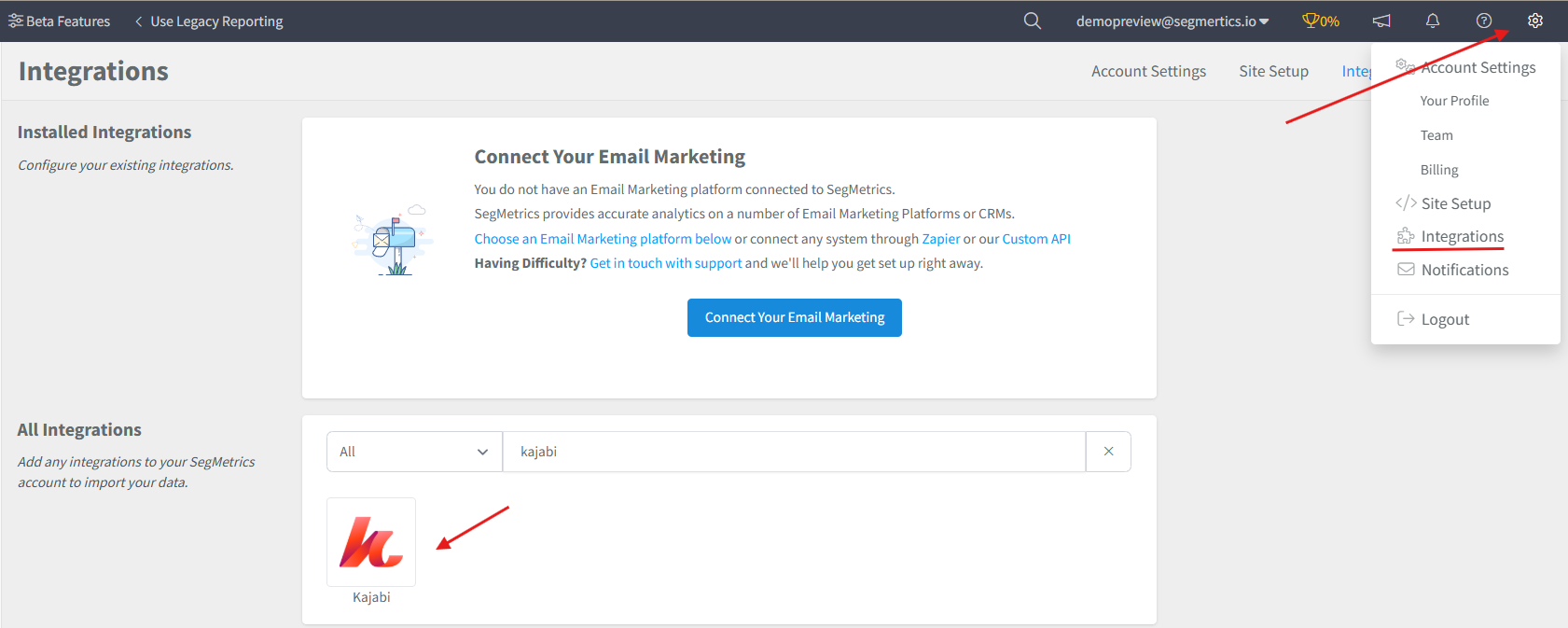
Method 2: Connect with Webhooks
Webhooks don't require an API key. They send less data than the API, so some fields may be missing in SegMetrics.
Prerequisites
- Kajabi Growth or Pro plan (required for webhooks)
- A SegMetrics account
Step 1: Enable the integration
- Email help@segmetrics.io and ask us to enable the Kajabi integration on your account.
- Once it's enabled, open https://app.segmetrics.io/a/integration/create/kajabi.
- Name the integration and click Connect Kajabi.
Step 2: Set up the webhook
Follow Option A or Option B, depending on how you use Kajabi.
Option A: Kajabi is your CRM
Use this if you manage contacts in Kajabi. It also covers Kajabi payments.
- Find your Account ID. In SegMetrics, click the gear icon and select Account Settings.
- Find your Integration ID. Click the gear icon, then Integrations. Click the three dots next to Kajabi and select Configure Integration. The Integration ID is the last number in the page URL.
- In Kajabi, go to Settings > Third Party Integrations & Webhooks.
-
Create a new webhook with this URL:
https://import.segmetrics.io/[Your Account ID]/webhook/[Your Integration ID]
Example: https://import.segmetrics.io/aMpXg5/webhook/13345
Option B: Kajabi is only your payment processor
Use this if you manage contacts in another CRM or ESP and only take payments through Kajabi.
- In SegMetrics, click the gear icon and select Integrations.
- Click the Kajabi option. If you don't see it, contact support.
- Label the integration Kajabi Payments.
- Select Payments and click Connect API.
- Copy the Account ID, Integration ID, and API Key from the next screen.
- In Kajabi, go to Settings > Third Party Integrations & Webhooks.
-
Create a new webhook with this URL:
https://import.segmetrics.io/[Account ID]/webhook/[Custom API Integration ID]
Track Visitors on Your Kajabi Pages
Install the SegMetrics tracking pixel on your Kajabi site to see the full customer journey, from first visit to purchase.
You don't need Kajabi as your CRM for this. If your Kajabi forms send contacts to another ESP or CRM, such as Kit, Mailchimp, or ActiveCampaign, connect that tool to SegMetrics. SegMetrics matches Kajabi page visits to those contacts by email address.
Step 1: Copy your tracking pixel
- In SegMetrics, go to the Site Setup page: https://app.segmetrics.io/a/settings/snippet
- Copy the tracking pixel code.
- Confirm your ESP or CRM is connected on the Integrations page and is syncing contacts.
New to the pixel? Read Installing the Tracking Pixel first.
Step 2: Install the pixel on your site pages
This covers landing pages, sales pages, blog posts, and other site pages.
- In Kajabi, click Settings.
- Click Site Details.
- Scroll to Page Scripts.
- Paste the pixel into the Header Page Scripts box.
- Click Save.
Header Page Scripts do not run on Kajabi checkout or upsell pages. Complete Step 3 to track those.
Step 3: Install the pixel on your checkout pages
- In Kajabi, click Settings.
- Click Checkout.
- In the Tracking Code section, paste the pixel into the Header Tracking Code box.
- Click Save.
For more detail, see Kajabi's guides on adding custom code to pages and adding tracking code to checkout pages.
Step 4: Test your setup
- Open a Kajabi page in a private or incognito window.
- Fill out a form with a test email address.
- Check SegMetrics for the test contact. It can take a few minutes to appear.
- To confirm the pixel is firing, go to Site Setup, scroll to the debugger at the bottom, and enter your Kajabi page URL.
How Contact Matching Works
- Email matching: When someone fills out a Kajabi form, SegMetrics matches the visitor to the contact by email address. All their Kajabi page visits join that contact's journey.
- Cross-session tracking: Once a visitor fills out a form, SegMetrics keeps tracking them across later sessions.
- UTM tracking: SegMetrics captures UTM parameters from your Kajabi page URLs automatically, so you can see traffic sources before a visitor opts in.
Import Historical Data
Kajabi does not sync historical data to SegMetrics. Kajabi's API limits this for most accounts. To bring in older data, import it by hand.
- Export from Kajabi. Export the contacts, purchases, or other data you need as a CSV file.
- Prepare the file. Check that the columns match the fields SegMetrics expects, and clean up any formatting issues.
- Import to SegMetrics. On the Integrations page, click the gear icon on your Kajabi integration. Select Contacts, upload the CSV, and map each column to a SegMetrics field.
- Check the results. Run a Leads report and compare the totals to Kajabi for the same date range.
For step-by-step CSV instructions, see Uploading Historical Data.
Alternative: Connect with Zapier
Requirements
- A Zapier account
- A SegMetrics account
- Kajabi Growth or Pro plan
Setup
- Create a Kajabi integration in SegMetrics on the Integrations page.
- Install the Kajabi Zap template.
- Connect your Kajabi account.
- Connect SegMetrics with your Account ID, API Key, and Integration ID.
- Turn on the Zap.
Note: Tools like Zapier, Make, and Pabbly can automate parts of the connection, but they send less data than a direct integration.
Frequently Asked Questions
Q: Which Kajabi plans work with SegMetrics?
A: Webhooks require the Growth or Pro plan. The Basic plan does not include webhooks or API access. The tracking pixel works on any plan.
Q: Do I need the Kajabi integration to track my Kajabi pages?
A: No. The pixel works on its own. You only need your ESP or CRM connected to SegMetrics and the pixel installed on your Kajabi pages.
Q: I use Kit as my CRM but have Kajabi landing pages. Will this work?
A: Yes. As long as your Kajabi forms send contacts to Kit and Kit is connected to SegMetrics, you'll see the full journey from page visit to sale.
Q: Will I see Kajabi page visits for contacts already in my ESP?
A: Yes. Once the pixel is installed, SegMetrics tracks any visitor it can match to a contact in your connected ESP.
Q: What if a visitor doesn't fill out a form?
A: SegMetrics still tracks the visit anonymously. It attaches the activity to a contact once that visitor identifies themselves, usually by filling out a form.
Q: Can I track more than one Kajabi site?
A: Yes. Install the same pixel on each site. All activity shows up in one SegMetrics account.
Q: How fast does data show up?
A: Page visits usually appear within a few minutes. Webhook data arrives in near real time. Matching visits to contacts can take longer, depending on when your ESP last synced.
Q: What time zone is Kajabi data synced in?
A: Kajabi data syncs in UTC. SegMetrics reports show it in the time zone set in your Account Settings.
Q: Do I need tracking links for Kajabi data?
A: No. SegMetrics collects domain, URL, and UTM data without them. Adding UTM parameters to your email links helps you measure specific campaigns.
Q: Could my imported data differ from Kajabi?
A: It can if field formats differ between the two systems. Always compare totals after an import.
Q: What are the limits of the Kajabi integration?
A: Most accounts don't have API access, historical data must be imported by hand, and webhooks take some setup. Third-party tools like Zapier fill some gaps but send less data.
Q: What about GDPR and privacy?
A: Make sure your Kajabi privacy policy mentions web analytics tracking. Add a cookie consent banner if your jurisdiction requires one.